Hello everyone. I’m Yamato Hiranuma.
It has been a while for those of you who used to read my activity reports.
From 2023 to 2025, I served as Head Coach of the Myanmar Judo Federation national team. In August 2026, I also began working as a member of JUDOs, a certified nonprofit organization.
With this new start, I was given the opportunity to continue writing in a way that follows on from the “Menden Judo ki ,” which I wrote while I was living in Myanmar. Under a new title, “Tatami no SOTO.,” I will be writing about my activities and about what I feel and think through them.
In the “Menden Judo ki ,” I shared my experiences of coaching and promoting judo in Myanmar, things that happened there, and the thoughts and feelings that came from my day-to-day activities.
With “Tatami no SOTO.,” I do not want to simply report what I have done. I hope to leave a record, in my own words, of what I felt and what I thought through those experiences as well.
This is the first issue.
To begin, I would like to explain why I decided to start writing again and what I wanted to express through the name “Tatami no SOTO.”
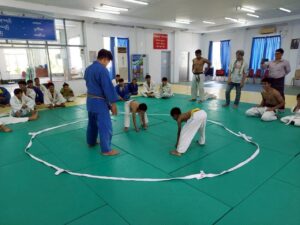
Photo 1 Children in Myanmar practicing sumo wrestling
Chapter 1 Why I Decided to Write Again
While I was working in Myanmar, I used the “Menden Judo ki ” to put into my own words what was happening at the time and what I was doing to promote and develop judo.
Looking back now, I am genuinely glad that I left a written record of what I did in Myanmar.
One reason is that it gives me something I can return to and reflect on later.
Memories naturally become less clear as time passes.
But when something is written down, I can look back and think, “That happened,” or “That was what I was thinking at the time.” It allows me to remember not only what happened, but also what I was feeling and thinking then.
Writing lets me keep a record not only of events, but also of my feelings and thoughts at that moment.
I think that is something only writing can really preserve in the same way.
Photo 2 “Menden Judo Diary” published on the JUDOs website
After I returned to Japan, something else happened that surprised me.
Since coming back to Japan, I sometimes help out at the convenience store my father runs.
One day, a regular customer suddenly said to me,
“I’ve been reading your Menden Judo ki.”
I was honestly very surprised.
He has no connection to judo at all, and I was not even sure whether he knew that I had been working in Myanmar. Still, I imagine that something led him to look up what I had been doing and read what I had written.
It made me realize that what I put out into the world can reach more people than I expect. It was one of those moments that made me think, “I’m glad I kept writing.”
Later, the same customer came into the store with his son.
I asked, “Where are you heading?”
He told me, “We’re going to a summer judo class at the police station.”
That surprised me as well.
Of course, I do not think his son started judo because he had read my activity report, and it would be presumptuous to make that connection.
Still, something I had written had reached someone I never expected, and judo also happened to be present somewhere close to that person’s everyday life.
That stayed with me.
By keeping a written record of my work with JUDOs as well, perhaps something similar will happen again: I may connect with someone in a place I cannot yet imagine, or a new relationship or activity may grow from it.
Of course, the main purpose is first to leave a record of the work I have been involved in, and to create something I can look back on myself.
And if that record happens to lead to a new connection with someone who reads it, I think that would be a wonderful thing too.
“Tatami no SOTO.” is the place I have been given to do that.
Chapter 2 Why “Tatami no SOTO.”?
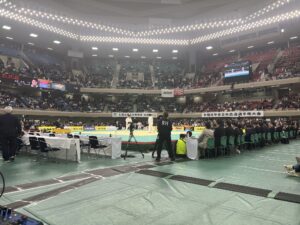
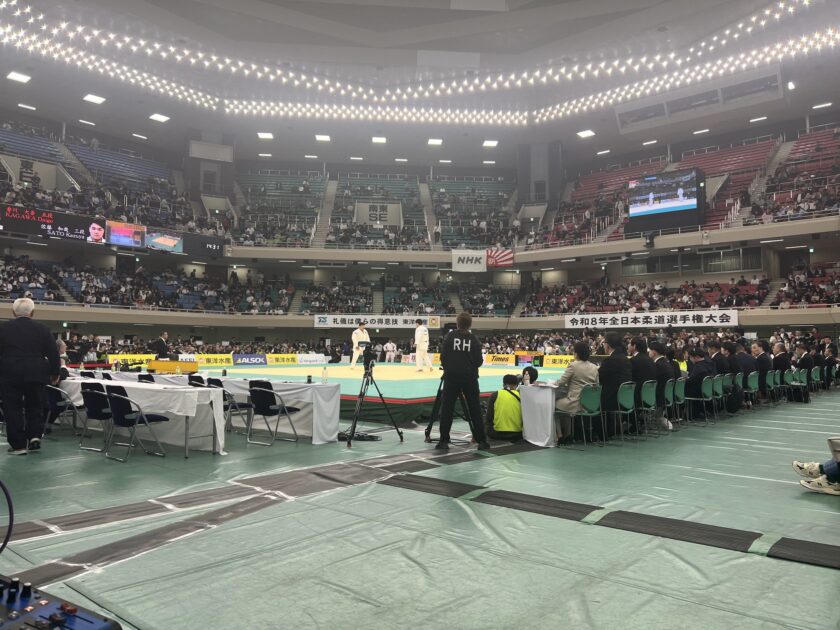
Photo 3 View from the side of the venue at the All-Japan Judo Championships
Until now, I think I have spent much of my time in the actual “field” of judo.
As a student athlete, I was always thinking, “How can I become stronger?” and “How can I produce results in competition?”
After I became a coach, the questions changed to, “How can I make my athletes stronger?” and “How can I help them grow?”
In Myanmar, my work went beyond strengthening the national team. I also had to think about questions such as, “How can we build a dojo?”, “How can we increase the number of people practicing judo?”, and “How can we promote and develop judo?” All of these were questions I faced directly in the field of judo.
A judo contest area has an “inside(jonai)” and an “outside.(Jogai)”
The contest area is surrounded by red tatami, with the space inside treated as “Jonai” and the space outside as “Jogai.” When a player goes outside, “Mate” is called, the match is stopped, and the athletes return to the center before continuing.
Thinking about it in that way, perhaps much of what I have done until now has, in a sense, taken place “Jonai” – in the field itself.
Competing as an athlete. Developing athletes as a coach. Teaching judo in a dojo. The work I will be involved in with JUDOs, however, also extends beyond those things.
For example, developing coaches and building relationships between them.
Delivering the tatami and judogi that people need in order to practice judo.
Creating environments where people overseas can continue practicing judo.
From a broader perspective, we also need to think about questions such as,
“How can the judo community itself continue to develop?”
and “How can we help sport develop in a better way?”
While I was working in Myanmar, I encountered many problems that could not be solved simply by teaching judo in the dojo.
How should an organization be run? How can people be connected?
How should decisions be made? How should management and governance be approached?
If judo is to be promoted and developed, I believe this kind of work “outside the tatami” is essential as well.
That is why, in this activity report, I want to write not only about what happens on the tatami, but also about the work taking place around and beyond it. And through that work, I want to put into words what I myself feel and think.
That is the idea behind the title “Tatami no SOTO.”
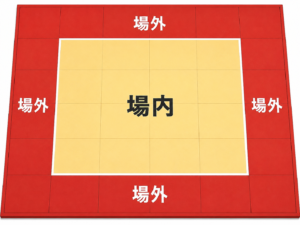
Figure 1 Illustration of the inside and outside of a judo contest area
So why did I write “SOTO” in katakana instead of using the kanji “soto”?
This is a small detail, but one I thought carefully about.
Katakana is often used for foreign words, but it is also used for technical terms and newer concepts.
For example, Japanese has pairs such as “テクニック” (technique) and “技術(gijutsu),” “ゲーム” (game) and “試合(shiai),” “コンディショニング” (conditioning) and “調整(chosei),” and “マネジメント” (management) and “管理(kanri).”
The meanings may be similar, but they do not feel exactly the same to me.
For instance, simply translating “management” as “管理(kanri)” can make the meaning feel a little narrower.
I feel something similar about “柔道” and “JUDO.
There is judo as it is practiced in Japan, judo in Europe, and judo in the Caucasus, including Georgia. The culture and ideas surrounding judo differ from country to country and region to region. It is not that only one of these is judo; there are many different forms of “JUDO” around the world.
For me, katakana carries that sense of something that cannot be contained within a single meaning or a single concept.
I feel the same way about the word “SOTO.”
I did not want it to refer only to the physical space outside the tatami. I wanted it to include the SOTO of the dojo, the SOTO of competition, the SOTO of Japan, and even the SOTO of the judo world I have known up to now.
I wanted the word to carry that broader meaning.
Rather than staying within one narrow idea, I want to encounter, think about, and work on the many different things that surround judo. That is the thought behind the name of this activity report: “Tatami no SOTO.”
Conclusion
So far, I have written about why I decided to start writing again and what I wanted to express through the name “Tatami no SOTO.”
At the same time, the more I turn my attention toward the “SOTO” of the tatami, the more I also find myself wondering whether that alone is enough.Looking at judo from the outside allows me to see things I could not see before. But if I move too far outside, I may lose touch with what is actually happening in the field. On the other hand, if I stay too deeply inside the field, I may fail to see what is happening around it. I do not think this is unique to judo; it probably happens in many different situations.
Even now, there are parts of my own future that I still cannot see clearly, including exactly what I want to do next. There are also many times when I am reminded of how much I still have to learn.
Even so, through many different connections and coincidences, I have been given opportunities to be involved in judo in places I never expected. I still do not know exactly how I will be involved in the field from here.
But I do know that I want to remain connected to the field of judo.
That is why, although this series is called “Tatami no SOTO.,” I do not want to look only at the SOTO of the tatami. I want to keep moving back and forth between the UCHI and the SOTO, and to keep thinking from both sides.
From where I am now, I can see judo and sport from perspectives that are different from those I had before. I can meet different people, listen to what they have to say, and come across new information. I believe there are things I can do precisely because of where I am now. For the time being, I want to value each opportunity in front of me, think about it in my own way, and keep moving forward.
This has become a little longer than I expected, so I will leave it here for this time.
Next time, I would like to write about how I first came across JUDOs, the support I received while I was working in Myanmar, and the “Online Cafe,” the first activity I joined as a member of JUDOs.
Through “Tatami no SOTO.,” I hope to gradually leave a record of what I see, what I feel, and what I think. Thank you for reading, and I hope you will continue to follow the series!
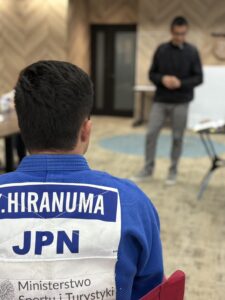
Yamato Hiranuma
Born in Hokkaido in 1997. Graduated from the Department of Accounting, Faculty of Commerce, Chuo University, where he was a member of the university judo club. After graduation, he competed as a corporate judo athlete with the Sports Hinomaru Kids Association before serving as an Assistant Coach of the Canadian national judo team. From 2023 to 2025, he served as Head Coach of the Myanmar Judo Federation national team, working to strengthen the national team and promote judo. Since 2026, he has been a member of the certified nonprofit organization JUDOs and also serves as an Information Science Staff member of the Japanese Olympic Committee.